 How Did You Count?
Review posted January 3, 2026.
A Stenhouse Book (Routledge), 2025. 36 pages.
Review written January 2, 2026, from my own copies, sent to me by the publisher.
Starred Review
2025 Sonderbooks Stand-out:
#3 Children's Nonfiction
Mathical Book Prize Winner, Grades K-2
First, my apologies to the author for not reviewing this book sooner. The publisher sent me copies of the book and teacher's guide when they were first published, because I so loved the author's previous books, Which One Doesn't Belong? and How Many?.
I did order copies for my library system and talked my coworker, who selects adult nonfiction, into ordering copies of the Teacher's Guide. I had to decide whether to write separate reviews for each book and where to put them, but I eventually decided to review the books together and post the review on my Children's Nonfiction page.
But then I got bogged down and put off reading the Teacher's Guide, even though I was intrigued by it. I ended up setting aside an hour to finish it off on the afternoon of New Year's Eve, because I knew it was going to be one of my Sonderbooks Stand-outs. (And I only count books I *finish* in the previous year.) So, here, at last, is my review of this book I'm completely delighted with.
Like with his other books, as you might discern from the titles, Christopher Danielson is the master of asking kids questions that don't have one right answer. And thus masterfully encourages children to explore and to engage in mathematical thinking.
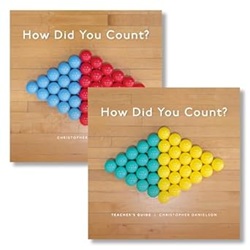
The basic picture book here shows objects arranged in some way - rows, triangles, circles, clusters. Beside the photos, the reader is asked "How many...?" and "How did you count them?"
As usual, he starts with a simple example that helps kids understand what's going on.
This is a book about counting, but not about right and wrong answers.
There are lots of interesting things to count. More important, there are lots of interesting ways to count them.
Once you know how many there are, count them in another way.
Turn the page to see what that means...
We see a photo of twelve tangerines arranged in a dish. The questions are asked. When you turn the page, across from the text are four smaller images of the same tangerines with lines drawn over them to show how they might have been counted.
Did you count the tangerines as four columns of three tangerines each?
Maybe you saw three zigzags of four tangerines.
Or two groups of six, or maybe you counted them one-by-one.
What other ways can you count the tangerines?
Various collections of objects follow. The most challenging to me was the tetrahedron made of basketballs. That page asked the usual questions, as well as, "Did you count any basketballs that you cannot see?"
At the back, the author says:
I made this book to spark conversation, thinking, and wonder.
It still makes my heart happy that a book about math can indeed spark those things.
Okay, all that's in the picture book itself. I do recommend the Teacher's Guide to elementary school teachers, to help you provoke those conversations and to start conversations with kids with genuine curiosity about their thought processes. I enjoyed the stories in the Teacher's Guide about the conversations the author had with kids when he brought this book into classrooms.
I marked this paragraph in the Teacher's Guide that shows the beauty of what's going on here:
How Did You Count? is a book about structures. You can count everything in the book one-by-one. But you can also count by twos or fives, or by pairs, rows, columns, triangles, or squares. The fun is less in knowing how many there are, and much more in making and sharing new ways to know how many there are. How Did You Count? supports a virtuous cycle where the more ways you know how to count, the more new ways you can think of. All of this is in service of a rich understanding of number and operation relationships in arithmetic, which is not only a worthy goal on its own, but it also builds intuitions that support later math learning beyond arithmetic.
I love my job as Youth Materials Selector so much, it's not often I miss working with the public. But reading the Teacher's Guide, I got the idea for an awesome library program: Make it a Family Math program. Start by going over pictures from the book. But have a large collection of objects of various sizes and amounts. And ask the families to arrange objects to make their own "How Did You Count?" photos, and invite them to take pictures of the arrangements on their phones (or have the librarian do it for them) and submit them to the author's website, talkingmathwithkids.com. (Since I can't do it, maybe I can talk some of my colleagues into doing it.)
(And if that doesn't sound like awesome, curious, exciting fun to you, I can't help you.)