
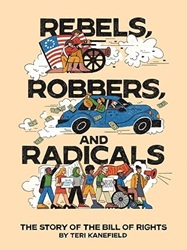
 Rebels, Robbers, and Radicals
The Story of the Bill of Rights
Review posted March 13, 2026.
Abrams Books for Young Readers, 2025. 216 pages.
Review written March 4, 2026, from a library book.
Starred Review
First, a note that this is not picture book nonfiction. I'll put it on the Children's Nonfiction page, but this is targeted to middle school and upper elementary students who can read longer material.
I love Teri Kanefield's legal writing. Her calm voice on her blog is long where I've gone to understand present-day legal issues. So of course I checked out this book for children on the Bill of Rights.
And I'd had no idea how interesting that topic could be. She explains her approach at the back of the book:
I hit on the idea of presenting the material the way the law is presented to law students - through actual court cases. The case method avoids abstract principles and tedious explanations. Instead, the law is presented through the stories and struggles of actual people. The principles and laws are woven into the fabric of the case the way morals are woven into fables.
Stories of real people involved in real struggles are always livelier than dry explanations, particularly when those stories include bank robbers like Bonnie and Clyde, high school students challenging violations of their rights, rebels who refuse to obey laws they believe to be unjust, and people considered radical because they want to entirely remake the government. The statement "you have the right to a jury trial" will have little relevance to most people. But when we read about the Zenger trial and see that juries were devised to guard against the kind of tyranny that early Americans experienced under British rule, the right to a jury takes on a real-world meaning.
Teri Kanefield achieves these goals in a book that's interesting every step of the way. She goes through each one of the first ten amendments and gives examples showing how the interpretation of each amendment affected people's lives - and still affect them today. She talks about how things have changed over time, about the conflict between states' rights and federal rights, and about things like how the "right to privacy" isn't mentioned in the Constitution, and how it's a question of the ninth amendment whether the federal government can rule on that.
Although this book is completely suitable for upper elementary age readers, I can testify that it's great reading for adults, too. As always with Teri's writing, I learned things about the law of our land that I hadn't known I didn't know.