
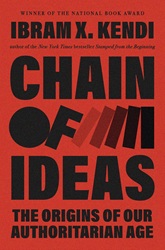
 Chain of Ideas
The Origins of Our Authoritarian Age
Review posted November 3, 2026.
Books on Tape, 2026. 20 hours.
One World, 2026. 550 pages.
Review written October 19, 2026, from a library book.
Starred Review
I checked out the audiobook version of this book, but I had some other audiobooks to listen to first, and I did not finish the book before the loan period of 21 days was up. I was impressed with the book, but the amount of information was a little overwhelming. I knew I'd want a copy of the book to write a review, so I decided to finish up by checking out the print version and reading that.
This book is a massive work of history. The author had so many notes, he put them on the internet instead of in the book - and it's still 550 pages long.
This book is about the global spread of "great replacement theory."
Great replacement theory can be defined as a political theory that powerful elites are enabling peoples of color to steal the lives, livelihoods, cultures, electoral power, and freedoms of White people, who now need authoritarian protection.
Great replacement theory is not only a racist and antisemitic idea. Like a virus, Camus's great replacement theory has mutated all over the world into sexist, ethnocentric, homophobic, transphobic, and especially Islamophobic variants. Appealing to men, ethnic majorities, heterosexual and cisgender people, and Jews and Christians (usually through a mythical "Judeo-Christian" construct), great replacement theories warn that women, queer and trans people, ethnic minorities, and Muslims are coming to take their lives, livelihoods, cultures, electoral power, and freedom: Feminists purportedly dominating men in South Korea. Transgender young people, who comprise less than 0.002 percent of collegiate athletes, said to be taking over sports in the United States. Albanians supposedly boxing out Macedonians in North Macedonia. Sub-Saharan Black Africans apparently displacing Brown Arabs in Tunisia. Muslims professedly terrorizing Hindus in India. Roma people apparently taking out non-Roma people in Central Europe. Homosexuals allegedly "grooming" heterosexuals in Russia. Even "evil" gangs ostensibly replacing "the good people" in El Salvador. Wherever there are lines between privileged and disadvantaged groups, between groups in the majority and the minority, new mutations of great replacement theory seem to arise.
It disturbed me how global this sweep of ideas has become. I was reading Kristen Kobes Du Mez's book Jesus and John Wayne during the same time period I was listening to this book, and there were times when they talked about the exact same thing, to the point where it felt repetitive and I couldn't remember which author had said which idea when. But Jesus and John Wayne talks about white Evangelicalism and the rise of Christian Nationalism in the United States. This book is about global politics.
The Chain of Ideas referred to in the title is about a series of linked political ideas that bring great replacement theory to authoritarian politics. And Ibram X. Kendi shows how the ideas in the chain have their roots in Naziism. Here's how the book is organized:
There are ten links in the chain of ideas. Each of the ten sections in Chain of Ideas tells the story of a single idea, set in a different nation, featuring a different great replacement politician as its main character, while chronologically narrating periods of electoral growth for great replacement parties. The sections connect these political ideas to their historical antecedents, making Chain of Ideas transnational and transhistorical. The seeds of great replacement theory emerged at the end of the nineteenth century "when the establishment of modern nationalism in the West concurred with the high days of European colonialism and imperialism," sociologists Sarah Bracke and Luis Manuel Hernandez Aguilar explain. Enslavers, colonizers, eugenicists, fascists, segregationists, dictators, apartheid officials, and - most of all - Nazis all expressed earlier versions of these same ten ideas, or of great replacement theory.
The book is 550 pages and 20 hours long, so I can't give as detailed a picture as I'd like. But let me give the section headings so you know what the ten ideas are in the chain.
Link 1: "Privileged groups lose out as disadvantaged groups gain."
This is the basic great replacement idea. This section features Marine Le Pen in France.
Link 2: "Inequity data should be ignored."
The whole great replacement idea is based on perceptions, not on facts. This section features Viktor Orban of Hungary.
Link 3: "Bigotry is prejudice and interpersonal discrimination."
Great replacement theorists don't want you talking about racist or bigoted systems. This section features José Antonio Kast of Chile.
Link 4: "Bigotry against historically disadvantaged groups is over."
This idea teaches that we have gotten past bigotry and racism. This section features Nigel Farage of the United Kingdom.
Link 5: "Bigotry against privileged groups is on the rise."
Make the privileged feel discriminated against, especially if any effort is made to adjust for historical inequities. This section features Geert Wilders of the Netherlands.
Link 6: "Majority and privileged groups are indigenous to the nation."
This is the idea that "real Americans," or the indigenous people in other countries are White folks, or precisely the groups with the most power. This section features Alice Weidel of Germany.
Link 7: "Fight for freedom as patriots, like the nation's founders."
Because privileged groups are the real patriots, fighting for their privileges is patriotic. This section features Pierre Poilievre of Canada.
Link 8: "Stand in the legacy of antislavery, anticolonialism, civil rights activism, and antifascism.
See how the ideas are linked? Because fighting for privileged groups is the real patriotism, they are in the noble legacy of all who have fought for justice. The politician featured in this section is Giorgia Meloni of Italy.
Link 9: "Insurrections against democracy protect the nation."
This is how you get the firm belief of the J6ers that they were protecting the country. This section featured Nayib Bukele of El Salvador.
Link 10: "Fight for privileges provided by dictators instead of power provided by democracy."
And so we see how great replacement theory has led us through this chain of ideas to authoritarianism. The politician featured in this section is Vladimir Putin of Russia.
You'll notice that Donald Trump doesn't get a section to himself. Rest assured that he is mentioned in every section. But this isn't a book merely about the United States. I learned much about what's going on in the rest of the world that I didn't particularly want to know.
I hope this all has intrigued you enough to pick up the book or place a hold for the audiobook. There's much information provided explaining and expanding on each link in the chain, especially giving examples relating to the featured politicians. I did like that the chapters are short. In the print book, that helps me grasp the ideas. (In the audiobook, it just barrels through chapters quickly; in print I can do a chapter a day and have an amount I can digest.)
Opening your eyes to underlying ideas is a good way to combat them. I hope this book will reach a wide audience.