
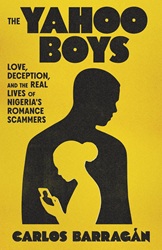
Love, Deception, and the Real Lives of Nigeria's Romance Scammers
Review posted August 12, 2026.
Farrar, Straus and Giroux, 2026. 287 pages.
Review written August 3, 2026, from a library book.
Carlos Barragán traveled to Nigeria to see if he could find his mother's scammer. He didn't find that particular person, but he did get to know several "Yahoo boys" - called that because emailing with Yahoo accounts was the main way they made money. This is the story of these young men, and how and why they do what they do.
Full disclosure: While I have never sent money to someone I met online (though I have fallen for a fake online store at least once), twice I emailed for a few weeks with a person from a dating site who turned out to be a scammer. And I do know of people who have lost money this way. So I don't have much sympathy for people who do this.
This book, though, helped me understand a little better how young men could fall into this. The economy in Nigeria is terrible. Legit jobs are hard to come by and don't pay well. But with romance scams, they can score big. And then they have a tendency to splurge each windfall and need more.
One of the boys the author interviewed got out of the scamming life for the sake of his grandmother - but his prospects are bleak, and his family doesn't have enough money for him to attend secondary school or continue with his apprenticeship.
The author also interviewed one American woman whom one of these scammers strung along for years - until she finally faked her own death to make him stop contacting her. This was after she'd lost thousands of dollars and even her home. The author went on a sleuthing expedition and finally tracked her down, with the promise that he would not tell the scammer that she is alive.
An interesting note is that scams go in waves. People are getting wise to the ways of romance scammers, and the Yahoo boys give each other tips of new things to try. The author interviewed one woman who was running adoption scams for tens of thousands of dollars, for example.
By the end of the book, while I still think that romance scams are a horrible thing to do, I feel a little more understanding of why people do them. And all the more careful about anyone I "meet" online. This book is fascinating like a train wreck, but also sad. Not only are lonely folks in the United States and Europe having their lives ruined, ultimately so are the people in Nigeria pulling off the scams.