
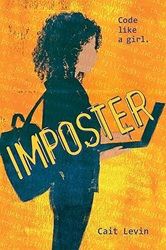
 Imposter
Review posted February 24, 2026.
Charlesbridge Teen, 2025. 232 pages.
Review written December 2, 2025, from my own copy, sent by the publisher.
Starred Review
2026 Mathical Book Prize Winner, Grades 6-8
Imposter is an issue book, but the character-building makes it much more than an issue book.
Cam is a high school sophomore who loves making. So she decides to take the intro to computer science class as her elective - and it turns out she's the only girl. The boys there - and even the teacher - treat her as if she doesn't belong.
But she has a supportive best friend, Viv, who joins her signing up for the Robotics team - to build a submarine robot to compete in San Diego the upcoming summer. Again, they are the only girls and face some pushback.
However, the only other Sophomore in Computer Science, Jackson, a guy who's always playing video games, agrees to be her partner for the big CS project. They decide to take on the problem of how women are treated in STEM fields - both in schools and in industry. Cam does research to back up their points, and Jackson uses her ideas to make a game where women overcome obstacles to defeat the big boss.
Along the way in both class and the RoboSub team, Cam keeps facing obstacles. She sees her own mother deal with a coworker being harassed at work, and gets motivated to stand up for herself.
As I started the book, I was skeptical of tackling this issue simply with a game shedding light on it. But as the book went on, I got more and more hooked by the characters. And the situations they faced as the story went on seemed all too realistic.
Without giving anything away, there are two little romantic subplots for each of the two girls, and I loved the way they turned out. It put the emphasis on their friendships and made this book more than just a typical YA romance.
By the end of the book, I was enthusiastically cheering for Cam and Viv. I know awareness alone won't solve all their problems, but Cam feels all the more equipped to tackle future obstacles and to help other girls follow her example.
I am sorry that the situation hasn't changed since the 1980s when I was a math student. This indeed sounds worse, since I was never harassed or made to feel like I didn't belong. But I was always definitely a minority in math and science classes. So I'm glad for another person shining light on the problem, complete with a lists of research and resources at the back. (Though let me also refer people interested in this topic to Eugenia Cheng's X + Y: A Mathematician's Manifesto for Rethinking Gender.